
April 10, 2025
Sandy:
Epinephrine is a serious, strenuous, and sustained Grade IV route, with 2240 feet (guide book) of climbing that approximately (my guess) averages around 78 degrees, including multiple vertical (90-degree) sections and a total of 640 feet of chimney pitches and 840 feet (upto pitch 12) of vertical and sometimes delicate face climbing . Some portions of the climb are also notably runout—these sections will be clearly pointed out in this report.
Before attempting a climb of this scale, I aimed to thoroughly research the route. To my surprise, despite Epinephrine’s reputation, I found only a handful of trip reports, scattered YouTube videos, and Mountain Project comments that felt like they are all over the place. In my humble opinion, the available information did not offer me a cohesive sense of whether we are EPI ready or not.
So, I decided to compile a detailed and structured trip report that could serve as a reliable resource for others who approach climbing the way we do: with a healthy respect for big objectives and a preference for being well-informed over well-surprised.
This report includes:
- Epinephrine Overview and Stats
- Group’s Experience with Grade IV Climbs
- Group’s Chimney and Off-Width (OW) Climbing Background
- Detailed Pitch-by-Pitch Route Beta, with attention to:
- Gear recommendations
- Difficult or awkward sequences
- Runout sections clearly marked
- Logistics and Timing Considerations
- Gear
Opinions in this trip report are based on our experience, the discussions we had with the three very strong parties (5.12 climbers) around us and all the grunting we heard from EPI while we were on Dreams of Wild Turkeys and Triassac Sands. If you’re a strong climber who enjoys mystery and thrives on the unknown, this trip report is not for you—consider it a spoiler alert. However, if you are a climber who likes to do thorough research about their routes and likes to be mentally prepared for all the challenges to really enjoy the whole experience then read on. My intention with this trip report is not to scare you but to help you answer the question: Are you EPI ready?
Backstory
My first trip to Red Rocks took place from November 20–24, 2023, immediately after completing my Research Proficiency Exam (RPE)—a rather intense checkpoint in my PhD journey. 2023 was, without exaggeration, one of the most stressful years of the last decade. I had just transitioned to a Principal Engineer role at Ampere Computing after 11 wonderful years at Intel, was grappling with a highly challenging adviser, and preparing for the RPE. Unsurprisingly, I wasn’t in shape for ambitious climbs at Red Rocks.
In May 2024, I made the difficult decision to switch advisers midway through my PhD—a choice that, in hindsight, was among the best I’ve made. My current adviser has been incredibly supportive, helping reduce unnecessary stress (conference deadlines still exist, of course, but now they’re more of a sport than a survival game) and allowing me to refocus on climbing.
In 2024, I logged 250 pitches—my highest annual total—including 173 trad (65 in Squamish, BC) and 69 sport routes. I also led a dozen and half 5.10- trad and a few 5.11- sport routes. From Thanksgiving 2024 to February 15, 2025, I practically lived in a research “dungeon,” along with my full time job. I singlehandedly conducted experiments, created diagrams, and wrote a full conference paper under the expert guidance of my new adviser. I submitted it on February 11, 2025.
After ECE PhD Day on March 8, I relocated to my property near Smith Rock to lead outdoors and train for our next Red Rocks trip (scheduled April 5–12, 2025). A cherry on top—on March 31, I was notified that my paper had been accepted for IEEE publication and an oral presentation in Tampa, Florida. Even better, the peer reviewers praised the topic, its timeliness, clarity of the paper, and organization—things every PhD student dreams of hearing.
Itinerary
April 5 : Hiked in IceBox Canyon and romped on Olive Oil from 3pm to 7:30pm.
April 6 : Needed a rest day which surprised us. I guess school and work wear us down more than climbing outside. We indulged in 60 minutes of Infrared sauna + cold plunge at NV Float Therapy which I highly recommend to calm the nervous system and enjoy deep sleep.
April 7 : Triassic Sands
April 8 : First two pitches of Dream of Wild Turkeys and first three pitches of Epinephrine with a 70m rope and a tag line.
April 9 : Recovery (Infrared sauna + Cold Plunge)
April 10 : Epinephrine
April 11 : Recovery (Infrared sauna + Cold Plunge)
April 12 : Trail run/hike/scramble Calico Basin, Calico Tanks and Ash Canyon – 7.5 miles and 2,065 feet
Epinephrine Overview and Stats
The height numbers are from guidebook. Hike stats are from my Garmin Fenix 7 watch.
| Number of pitches | 16 (12 + 4 ramp pitches). We did it in 14 pitches while simul climbing last 4 pitches. |
| Total height of the climb | 2240 feet, according to the guide book |
| Total height of chimney pitches | 640 feet |
| Total height of remaining climb | 840 feet (P6 to P12) + 700 feet (EPI ramp) = 1540 feet |
| Car to base of Epi | 1.26 miles, 553 feet of ascent with a class 4 scramble. Took us 53 minutes |
| Climb time | 11 hours 48 minutes |
| Summit to car | 2.05 miles with a total descent of 2400 feet and short ascent of 223 feet. Took us 2 hours 38 minutes. |
| Start and Finish Time | Started hiking at 4:59am and reached the car at 8:33pm. Car to Car 15 hours 34 minutes. |
Group’s Experience With Grade IV Climbing
Grade IV is defined as a full day of technical climbing generally at least 5.7. I would rate EPI as the most challenging grade IV climb compared to the previous ones listed in the table below.
As I was making this list I realized that Rick has led Angel’s Crest and East Buttress of Middle Cathedral as one block. So I was searching for routes that I have led as one block.
| Name of route | Grade | No. pitches | Place | Vertical climb (meters/feet) | Year | Trip Report |
| Angel’s Crest | 5.10b | 13 | Squamish, BC | 600/1970 | 2024 | https://dashertonclimbs.com/2024/07/18/angels-crest-5-10b/ |
| Long Time No See and Squamish Butt Face | 5.9 | 15 | Squamish, BC | 373/1225 | 2023 | https://dashertonclimbs.com/2023/07/14/the-chief-via-long-time-no-see-squamish-butt-face-5-9/ |
| Royal Arches | 5.7 A0 | 15 | Yosemite, CA | 609/2000 | 2022 | https://dashertonclimbs.com/2022/05/23/royal-arches-5-7-a0/ |
| East Buttress of Middle Cathedral | 5.9 A0 | 11 | Yosemite, CA | 335/1100 | 2021 | https://dashertonclimbs.com/2021/06/21/east-buttress-of-middle-cathedral-5-9-a0/ |
| Direct North Ridge, Mt. Stuart | 5.9+ | 20+ | Mt. Stuart area, WA | 853/2800 | 2019 | https://dashertonclimbs.com/2019/08/20/north-ridge-of-mt-stuart/ |
Sandy’s Lead for Entire Routes
| Name of route | Grade | No. pitches | Place | Vertical climb (meters/feet) | Year | Trip Report |
| Diedre | 5.8, II | 6 | Squamish | 242/800 | 2024 | https://dashertonclimbs.com/2024/07/18/diedre-5-8/ |
| Dark Shadows | 5.8, II | 4 | Red Rocks | 106/350 | 2023 | https://dashertonclimbs.com/2023/12/04/dark-shadows-5-8/ |
| Frogland | 5.8, III | 6 | Red Rocks | 212/700 | 2023 | https://dashertonclimbs.com/2023/12/04/frogland-5-8/ |
| East Ridge Direct, Forbidden Peak | 5.8-, III | 6 | Boston Basin, WA | 2019 | https://dashertonclimbs.com/2019/08/04/forbidden-peak-east-ridge-direct-5-8/ | |
| Southeast Buttress of Cathedral Peak | 5.6, II | 5 | Tuolumne Meadows, CA | 212/700 | 2020 | https://dashertonclimbs.com/2020/07/28/se-buttress-on-cathedral-peak-5-6/ |
| Matthes Crest Traverse – South to North | 5.7, IV | Tuolumne Meadows, CA | 758/2500 | 2020 | https://dashertonclimbs.com/2020/09/12/matthes-crest-5-7-fleeing-the-fire/ |
Group’s Chimney and Off-Width (OW) Climbing Background
| Name of route | Chimney/OW pitch number | Grade of the pitch/pitches | Type | Place | Year | Trip Report |
| East Face of Lexington Tower | P6, P7 | 5.8+ | Flaring awkward chimney, OW | Liberty Bell, WA | 2019 | https://dashertonclimbs.com/2019/07/28/nw-corner-on-north-early-winter-spire-5-9-and-the-east-face-of-lexington-tower-5-9/ |
| North Ridge Direct, Mt. Stuart | P2, Gendarme P2 | 5.8, 5.9+ | Squeeze Chimney, OW | Mt. Stuart, WA | 2019 | https://dashertonclimbs.com/2019/08/20/north-ridge-of-mt-stuart/ |
| Stanley-Burgner | P5 | 5.9 | Flaring Squeeze Chimney | Prussik Peak, WA | 2019 | https://dashertonclimbs.com/2019/07/15/prusik-peak-stanley-burgner-5-10a/ |
| East Buttress, Mt. Whitney | P8 | 5.6 | OW | High Sierra, CA | 2020 | https://dashertonclimbs.com/2020/07/31/confirmation-on-mt-whitney-east-buttress-5-7/ |
| Selaginella | P1, P2, P3 | 5.7, 5.7+, 5.8+ | OW, Bombay Chimney, Chimney/Flare | Yosemite, CA | 2022 | https://dashertonclimbs.com/2022/05/23/commitment-5-9-and-selaginella-5-8/ |
| Royal Arches | P1 | 5.6 | Slick Chimney | Yosemite, CA | 2022 | https://dashertonclimbs.com/2022/05/23/royal-arches-5-7-a0/ |
| Absolutely Free | P5 | 5.9 | 5″ OW | Yosemite, CA | 2022 | https://dashertonclimbs.com/2022/11/01/absolutely-free-5-9/ |
| Braille Book | P4 | 5.8+ | Foreboding slick arching OW | Yosemite, CA | 2022 | https://dashertonclimbs.com/2022/05/23/braille-book-5-8/ |
| Squamish Butt Face | P6 | 5.5 | Squeeze Chimney | Squamish, BC | 2023 | https://dashertonclimbs.com/2023/07/14/the-chief-via-long-time-no-see-squamish-butt-face-5-9/ |
| Ahab | Single Pitch, 130 ft | 5.10b | Narrow chimney | Yosemite, CA | 2022 | https://dashertonclimbs.com/2022/11/01/yosemite-season-2-in-2022/ |
| Moby Dick | Single Pitch, 130 ft | 5.10a | OW | Yosemite, CA | 2022 | https://dashertonclimbs.com/2022/11/01/yosemite-season-2-in-2022/ |
| Generator Crack | Single Pitch, 60 ft | 5.10c | OW and narrow chimney | Yosemite, CA | 2022 | https://dashertonclimbs.com/2022/11/01/yosemite-season-2-in-2022/ |
| Dolphin | Single Pitch, 70 ft | 5.7 | OW Squeeze Chimney | Joshua Tree, CA | 2021 | https://dashertonclimbs.com/2021/12/26/transcending-climbing-experience-at-joshua-tree/ |
| Rodeo Crack | Single Pitch, 70 ft | 5.10 | 5″ OW | Trout Creek, OR | Multiple | |
| Wiggle Room, The | Single Pitch, 60 ft | 5.10- | Chimney | Trout Creek, OR | Multiple | |
| Religious Fervor | Single Pitch, 70 ft | 5.10a | Wide/OW | Lower Gorge, OR | Multiple | |
| Taxtor | Single Pitch, 80 ft | 5.9 | Wide crack | Lower Gorge, OR | Multiple | |
| Mines of Moria | Single Pitch, 70 ft | 5.8 | Chimney | Lower Gorge, OR | 2024 | |
| Girls with Chim(n)ay | Single Pitch, 90 ft | 5.10- | Chimney | Trout Creek, OR | 2024 |
Challenges of EPI
- Sustained at grade : I currently lead 5.11- sport and 5.10- trad, while Rick leads 5.12 sport and 5.11- trad—so on paper, 5.9 should feel casual. But Epinephrine tells a different story. To give some perspective: when cragging at Trout Creek (notorious for its steep, physical crack climbing) or Lower Gorge at Smith Rock (steep basalt cracks), we typically do five 5.10 trad pitches over 6 hours, with ample breaks—shoes off, water and snacks. We usually cover 300–400 feet in a session. Epinephrine, however, demands continuous climbing with minimal downtime. While the individual moves in this entire climb are not so difficult, you’re climbing pitch after pitch to stay ahead of daylight, and the chimneys—nearly vertical and relentlessly sustained for 630 feet—are full body climbing. Above that, through pitch 12, it transitions into 840 feet of steep face climbing, involving delicate smearing and pulling on flat edges. Unlike the lower half, the upper pitches require almost no jamming—just a good memory for your foot placements and a tolerance for foot pain.
- Feet are going to hurt – After completing several alpine climbs in Washington, our trips to Yosemite in late June 2021 and late May 2022 highlighted two key differences. First, multi-pitch routes like the East Buttress of Middle Cathedral felt noticeably steeper, more sustained, and physically demanding at their grade compared to the Washington alpine routes, which typically feature isolated cruxes. Second, prolonged exposure to heat during steep Grade IV climbs significantly amplifies foot pain—a lesson we learned the hard way. I’ve previously written about this in trip reports for both Nutcracker and East Buttress of Middle Cathedral. On Epinephrine, despite being in the shade for much of the climb, we hit direct sun between pitches 6 and 8. With temperatures soaring to 94°F, foot pain became a serious issue once again. Fortunately, Advil proved to be the real MVP of the afternoon.
- Carrying weight will wear you down – Two Mountain Project comments resonated strongly with our experience: i) The Black Velvet Wall follows an old-school grading system—expect climbs that are steeper, more sustained, and does not ease off. ii) One party mentioned carrying 4 liters of water and feeling completely drained. Both points are absolutely true. Leader already bear the burden of the rack and must manage rope drag—particularly challenging in the chimney sections where careful extension are essential. For this reason, we decided that the follower do the hard work of carrying all the weight such as liters of water, food and extra layers. But be prepared- even those climbing well below their limit may find 2240 feet of climbing exhausting under load.
- Run out sections and spinning bolt hangers on upper pitches – There are run out sections on chimney pitches as well as upper pitches which I will point out in the pictures. Alot of the bolt hangers on upper face climbing pitches were revolving and Rick was sometimes backing it up with gear.
Logistics
1. Woke up at 3am and started driving from our AirBnB at Summerlin Rainbow area at 3:50 am.
2. Got to the Black Velvet Canyon Parking by 4:50am.
3. Started hiking at 4:59am. We had already seen two head lamps deep into the valley as we were getting close to parking. This was the first party who had done this route before and were doing 80m pitches.
4. Reached the base of Epinephrine at 5:52am. It took us 53 minutes at 66 degrees morning temperatures on April 10th. We were the second party and had 3 Canadian parties who reached EPI base just 10 minutes after us.
5. Started climbing at 5:58 am and summitted at 5:45pm. Climb time 11 hrs 48 minutes.
6. Started descending at 5:55pm and reached the car at 8:33pm. Descent time 2 hours 38 minutes with one hour descent in the dark. This was the descent from Frogland and we are familiar with this descent since we had done Frogland on Nov 21, 2023.
7. Follower carried 3.5 liters of water for the group, wraps for feast of summit (which was postponed until we reached the car), bars, approach shoes (Rick graciously clipped his approach shoes on his harness) and layers for each person. We had two packs of electrolyte and salt in all the water bottles. I think this idea worked very well to carry less water and still feel comfortable. We rationed our water and had 3/4th of a liter left for the descent. We both drank 2 liters each as soon as we got to the car.
8. Would have been nice to have my broken in TC Pros instead of the newly resoled ones which became quite tight and very uncomfortable as my feet swelled during the climb. It was a 94 degree desert day and we were in sun from top of Black tower to the top of the Elephant Trunk.
Gear
1. Double rack up to two #3, three #2s (useful once for crux chimney pitch i.e. P4) and one #4. Totems for .75, .5, .4, .3, .2. A set of nuts.
2. 8 single length slings, 1 double, and 3 draws.
There are mountain project comments on bringing a single rack but we were glad for the gear we brought and the 5.13 Canadian climber below us humbly said, “I read those comments and brought more gear”. With a surprise in his tone he said “and I am using them”.
Detailed Pitch-by-Pitch Route and Gear Beta with Information on Runout Sections
Before getting on EPI, I highly recommend brushing up chapter 6 and chapter 7 of Pete Whittaker’s Crack Climbing book. Those techniques were very useful to cruise through the chimney pitches. All of the beta is discussed in image captions. The pictures for the first three pitches are from our EPI scouting endeavor on the afternoon of April 8th. Therefore you will see the rope and tagline attached to Rick. Tagline disappears in pictures from P4 onwards because they were taken on April 10th, during our EPI day. Rick graciously hauled my pack on the chimney pitches: 4 and 5 which made those pitches much more enjoyable.
I have the GPX tracks for both the approach to the base of Epinephrine and the descent. If you’re interested, please comment on this post—I’ll share the files to the email address visible in your comment.
I noticed that the pictures and font are larger and details of pictures are a lot clearer on a monitor switched to portrait mode.

Pitch 1: 60′, 5.8: It is surprising to me that no one mentions the challenges of this pitch. At first glance, it resembles the start of Dark Shadows, but in reality, it’s noticeably harder. You begin by using the tree to clip the first bolt, and the second bolt is also within easy reach. However, the real challenge emerges between the second and third bolts—there’s a significant gap on a relatively featureless wall that leaves you questioning, “Is this really 5.8?” A few delicate moves later, you find yourself above the third bolt, standing on a small ledge with trees, as shown in the following photo.

Pitch 1: 60′, 5.8: Crux between second and third bolt.

Pitch 2: 110′, 5.7: I started annotating the pictures for gear but it looked busy and ugly in later pictures so I decided to just mention it in the comments in later picture. We used totems (be careful they may get stuck, we almost lost a .4 and .3 on upper pitches). #3 is right above the ledge of pitch 1 and .4 is on the left facing corner.
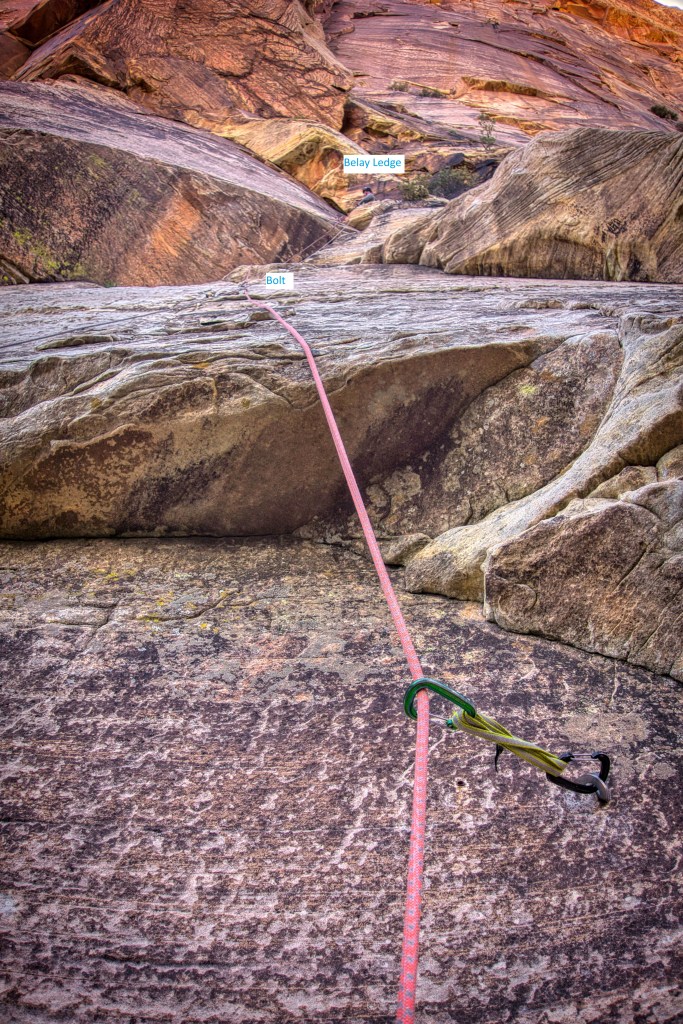
Pitch 2: 110′, 5.7: This section is after you pass the small roof on left facing corner. The two bolts here are almost at the end of both slab sections.

Pitch 3: 150′, 5.8: This is where the chimney fun begins. The first piece is totem .5. After that there is short easy section which can be protected with a #2.

Pitch 3: 150′, 5.8: The chimney on this pitch is around a 100 feet tall with lots of options to stem. During our scouting trip on April 8th, I stemmed and found it harder. On April 10th, I did chimney moves and found it to be easier and energy conserving. The pro in the picture is a .3.
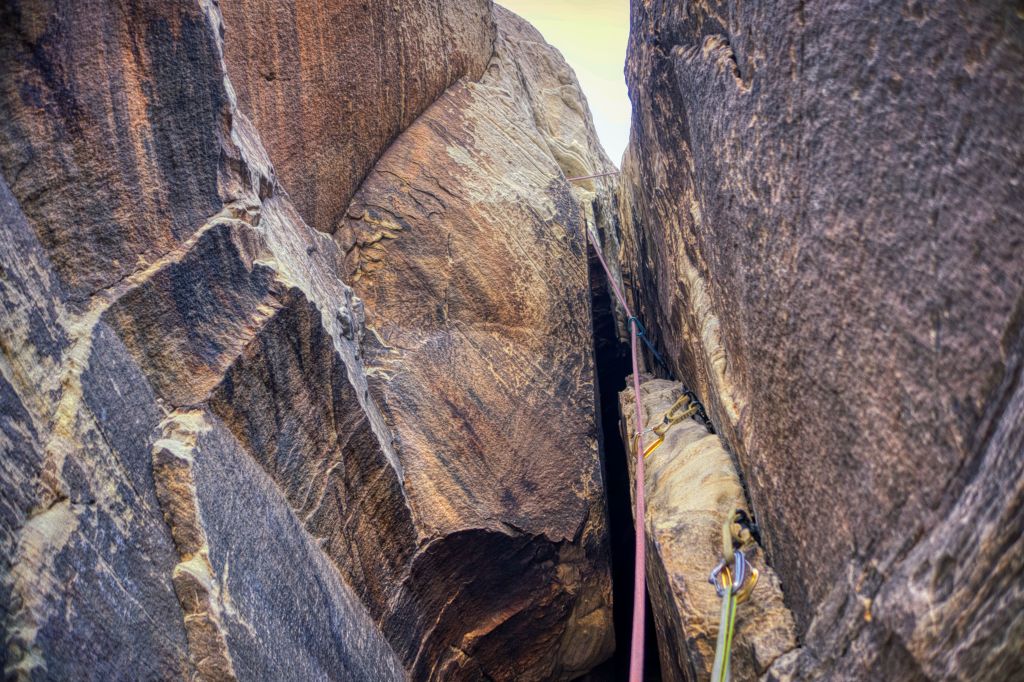
Pitch 3: 150′, 5.8: This picture shows the exit of chimney on pitch 3, which is quite tricky based on Rick’s comment and the comment of the leader of the party that was behind us. Pro from bottom to top is .4, .4, .3 and the key pro before you exit is almost a blind placement of #1 on the left which is has a perfect horizontal crack.

Pitch 3: 150′, 5.8: After exiting the chimney, enjoy the brief reprieve of an easy slab—protected nicely with a hand-sized piece at its base. From the belay ledge, you’ll get your first intimidating view of the steeper chimney system above. During our scouting trip, I optimistically thought I could see the top of the Black Tower from that very ledge and wondered, “If that’s the top, how can there still be 380 feet of chimney climbing left?” Well, as it turns out, the top is much farther than it looks—classic desert wall illusion. What looks like “just around the corner” is, in reality, three full pitches of full-body climbing—complete with back-scraping friction, awkward chimney shuffling, and a generous helping of cursing and grunting to keep the rhythm going.

Pitch 4: 110′, 5.9: This is the crux chimney pitch. The only relatively easy section is where Rick is in the picture above. After that you enter into the left chimney system and inch your way up. I will describe why its the crux in the captions below. For this section gear from bottom to under the small roof feature you see right below the chimney system is as follows: Two finger sized pieces below Rick before the crack widens, #2 above the wide part of the crack right below Rick’s leg and .75 right under the small roof feature. If you look carefully you will see the follower of the party above us in the chimney and his leader’s two legs from the belay ledge where pitch 4 ends.

Pitch 4: 110′, 5.9: I took this photo shortly after entering the pitch 4 chimney. In several videos, the two prominent bulges shown here seemed to mark the crux—but in my experience, the true crux lies in the final 12 feet above the second bulge, just before the belay ledge. That stretch demanded the most effort and focus. The entire pitch is a sustained chimney workout. I remember wondering if the chimney was truly as steep as it appeared in the videos. Now having climbed it, I can confirm—yes, it’s every bit as steep as it looks. In the photo, you can see the follower above us hanging, and Rick is the small figure to his left, looking down toward me. Gear placements from the base up to the second bulge were: a #1, followed by five placements under the second bulge—primarily #2s and a #3. This is where having three #2s felt psychologically comforting. There’s also a fixed #2 in place. The next solid piece above the second bulge was likely a #3. The most efficient way to climb this section is with your back against the left wall, chimneying upward. There’s a crack on the left that allows for hand jams, but I found those more strenuous than helpful. Once above the bulges, you can snag a short rest by leaning your left side against the ledge—a welcome pause before the next stretch.
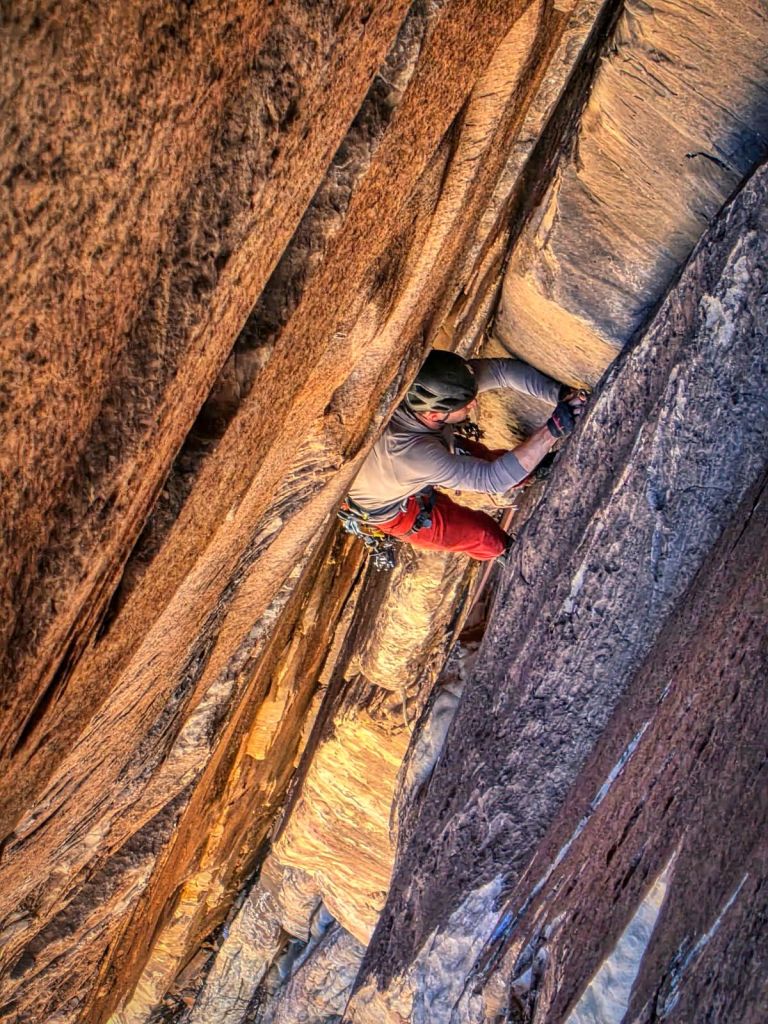
Pitch 4: 110′, 5.9: The party above us graciously took this gorgeous picture while Rick was leading. Here Rick is at the first bulge.
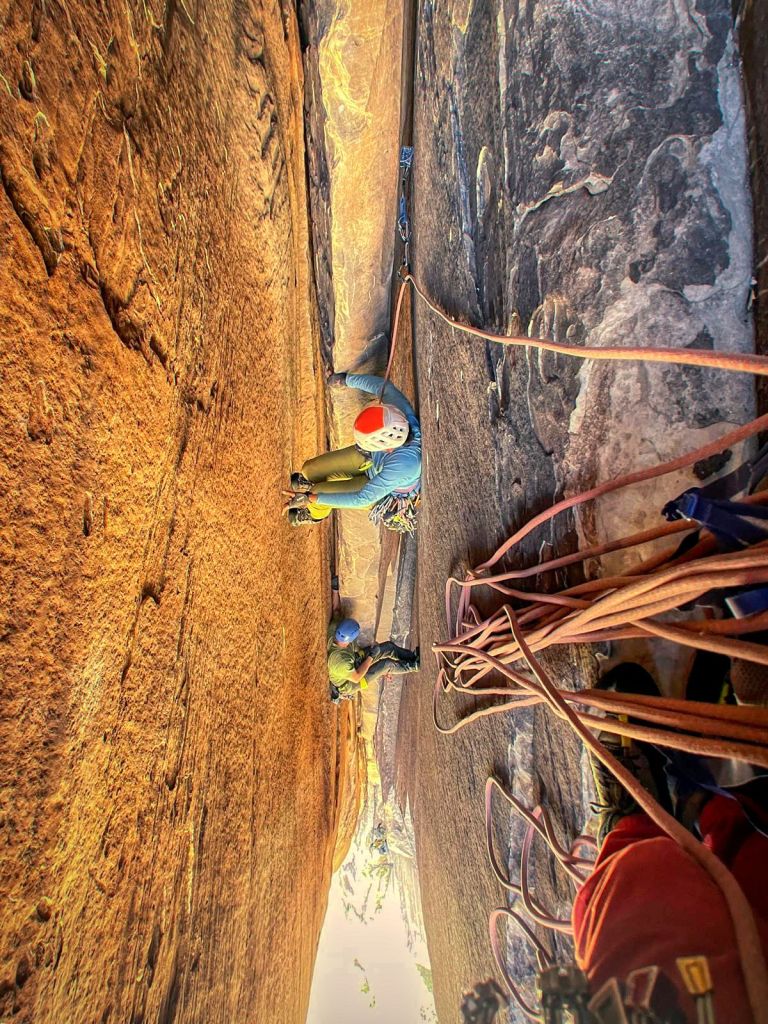
Pitch 4: 110′, 5.9: This photo captures the section just above the second bulge—and yes, it’s long, sustained, and in my experience, harder than the bulges themselves. The leader of the party below us is probably resting at the second bulge. As shown, the crack on the left widens into an offwidth (#5 can protect this section and probably a couple sections in the two chimney pitches above P4. But they are the only places in the entire route for a #5), and even fist jams were out of reach for me. I initially tried a few butterfly moves in a chimney position at the start of the offwidth, which may work for short rests, but it’s not a sustainable strategy. The more efficient approach is to continue chimneying upward with your back on the left wall, pressing with both hands against it until the right wall narrows enough to accept a hand-sized cam. At that point, I transitioned to chimneying with my back against the right wall. In the videos, the right wall had appeared coarse and dry alluding to friction, but take note—it’s actually quite slick in this section, so make the switch carefully. Once established, place a #3 in the right-side crack and move delicately up to the belay ledge.

Pitch 5: 150′, 5.9: Pitch 5 has two bolts, one about a foot above the anchor as visible in the left corner of this picture and one above Rick. After clipping the second bolt, continue chimneying for a little bit as Rick is demonstrating in this picture and then perform a very careful cross over to the right side wall as shown by the follower of the party ahead of us in the picture below.

Pitch 5: 150′, 5.9: Careful crossover demonstrated by the follower of the party above us.

Pitch 5: 150′, 5.9: P5 after crossover section protects with a finger sized piece on the left crack and possibly a #5 right below Rick’s right leg. Rick said this section was quite heady.
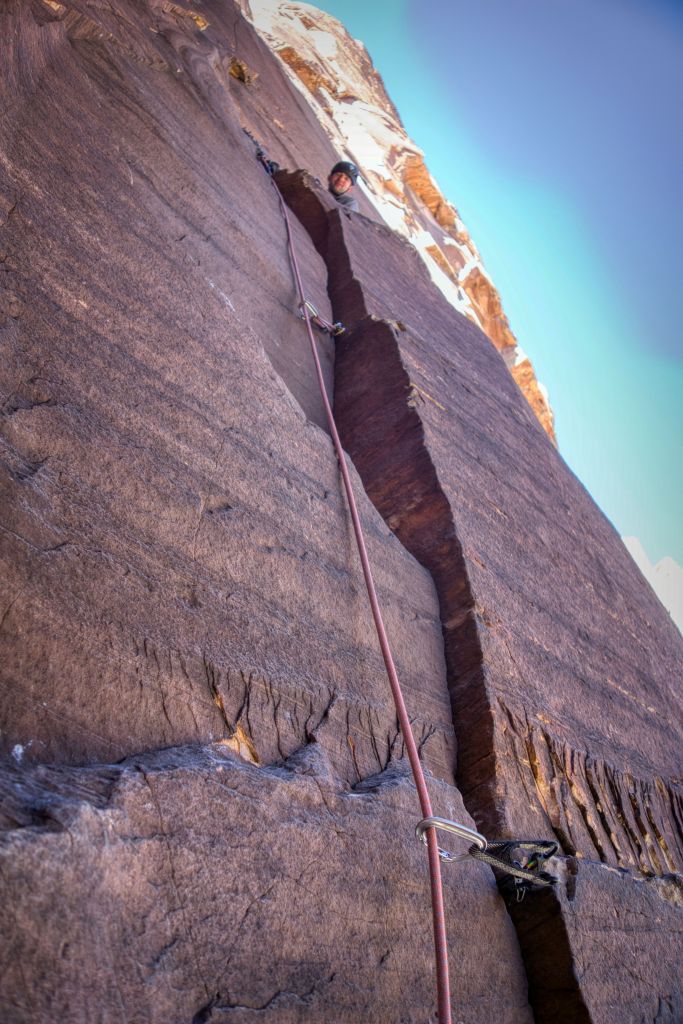
Pitch 5: 150′, 5.9: Pitch 5 finish with a black totem (.2) and a hand size piece above. Its a lovely hand crack. Getting on P4 belay ledge is intense but getting on to this ledge was a breeze.
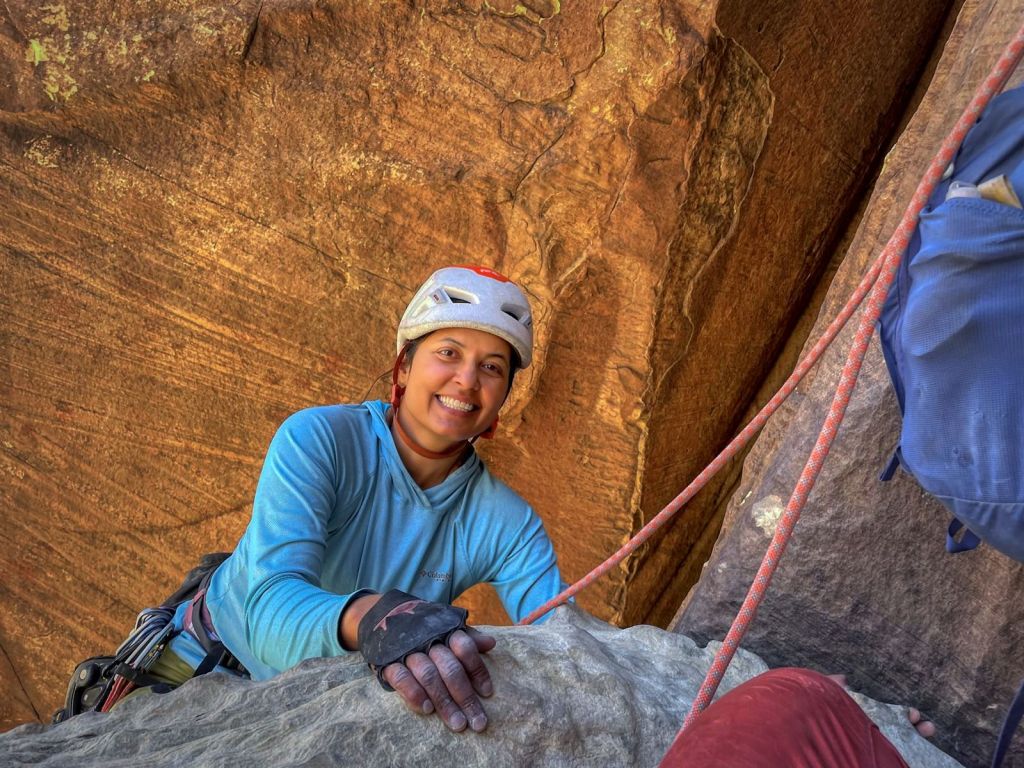
Pitch 5: 150′, 5.9: Nothing but joy after finishing 3 out of 4 chimney pitches.
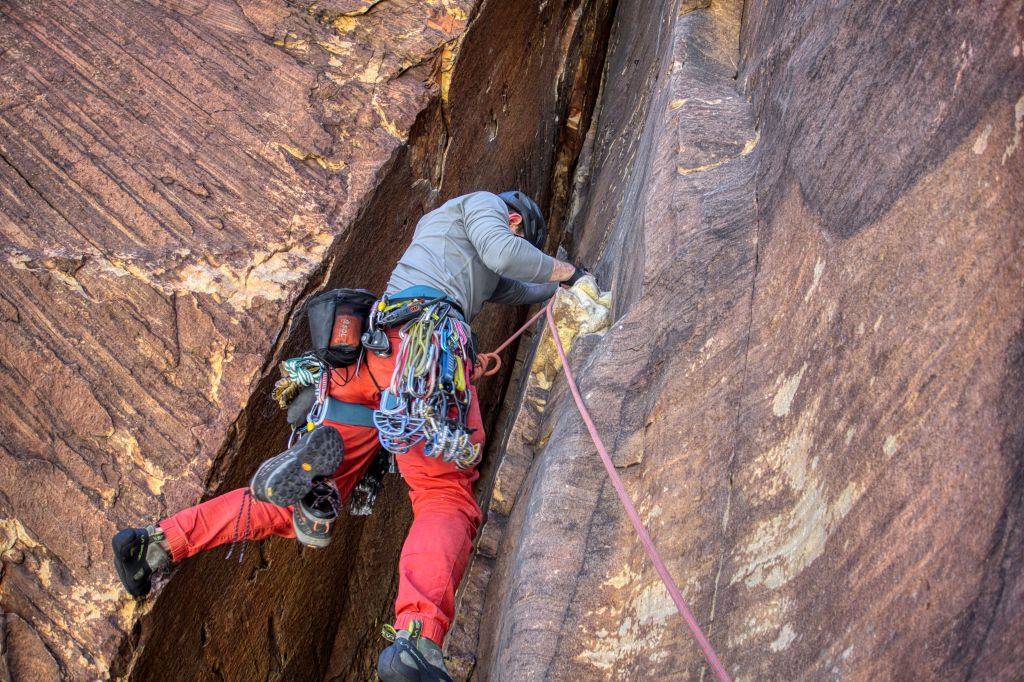
Pitch 6: 120′, 5.9: This gives you the taste of a runout chimney. There are two bolts in this chimney and gear is almost impossible unless you want to squeeze in deeper into the chimney. Exiting the chimney can be protected with a #4.

Pitch 6: 120′, 5.9: To fly through this chimney I highly reccomend studying chapter 6 and chapter 7 of Pete Whittaker’s Crack Climbing book. There are lots of edges on the left wall for resting in between so the best way to climb is by shimming up with back against the right wall. Rick used the narrow and medium chimney techniques described in the book and found this chimney quite easy. However the two leaders behind us (5.12 Canadian climbers) found this chimney quite heady and scary. Take a well-earned rest and soak in the views from the top of the Black Tower—but don’t get too comfortable. You still have roughly 840 feet of steep face climbing followed by another 700 feet of EPI ramps. In other words, congratulations—you’re halfway through the foreplay.

Pitch 7: 180′, 5.7: At this point we let the party behind us passed because they politely requested us and they were very competent and strong climbers. They summited 90 minutes before us but we wasted about 30 minutes on two of our totems that got stuck on P10 and P11. We all regrouped at the summit and chatted for a bit. They were waiting for their other two parties that were behind us. This pitch really surprised me because its rated as 5.7 but as you can see its steep face climbing on thin edges. Its a bit run out as well because the only pro before the ledge is a bolt as visible in the picture above with a red sling. Once you are on the ledge (the red backpack of the leader of the party that we let pass us), you can protect the right side crack with a 3 or 4 and pull on some roof jugs to get your feet. I am 5’7″ and this section may feel easier for taller people.
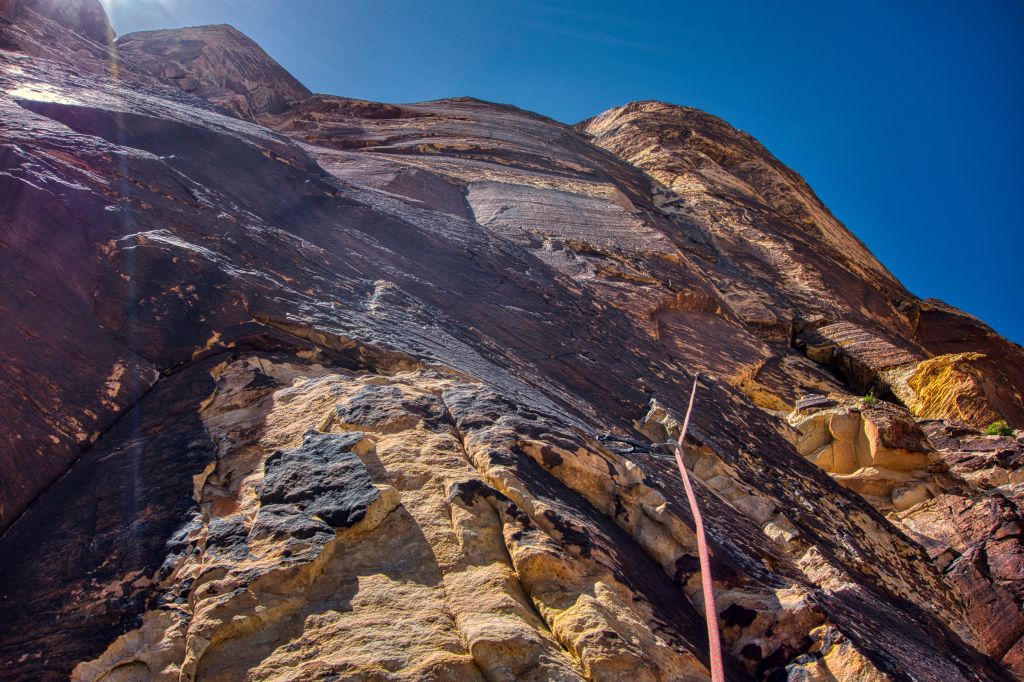
Pitch 7: 180′, 5.7: Upper section of pitch 7. The belay in the Handren book is a few ratty slings on a detached block. If you go to the top of the Elephant’s Trunk labeled as the ‘optional belay’ there’s a bolted anchor. Black totem and another finger piece for pro on the face.
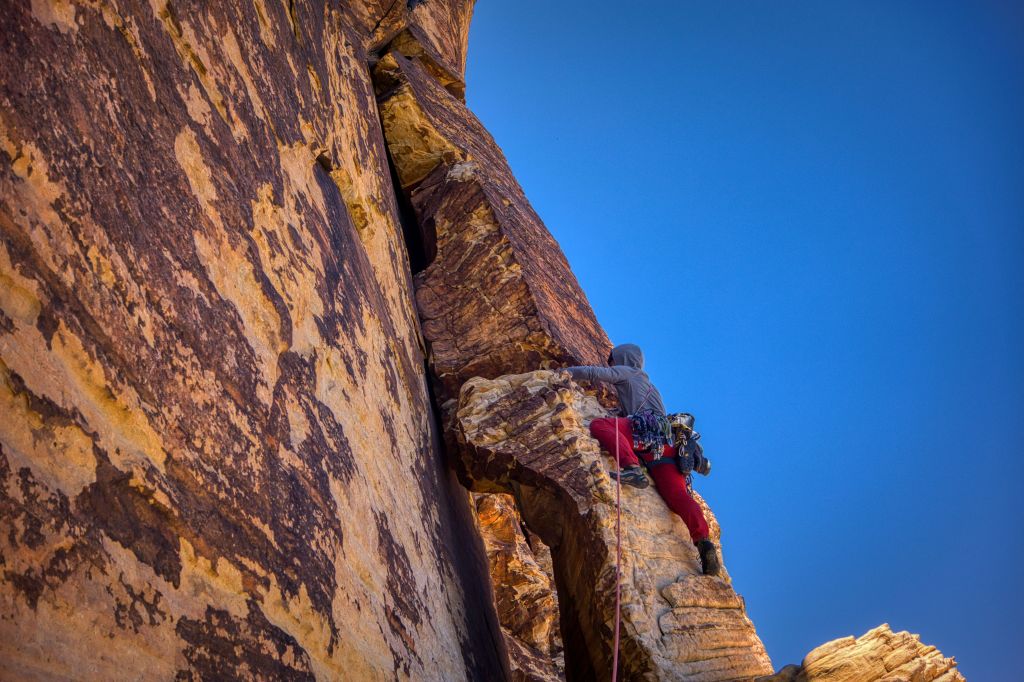
Pitch 8: 80′, 5.9: Rick leading Elephant Trunk, this section is easy and the horizontal crack where Rick has his hand can be protected with hand sized piece.

Pitch 8: 80′, 5.9 : Sandy on top of the Elephant Trunk feature. The rest of the discontinuous crack can be protected with small gear and nuts but the I felt that the crux is the last 6 feet below the belay ledge as visible in the picture below.

Pitch 8: 80′, 5.9 : Pitch 8 finish has interesting moves before getting on to the ledge. 0.5 sized piece for this right side crack.
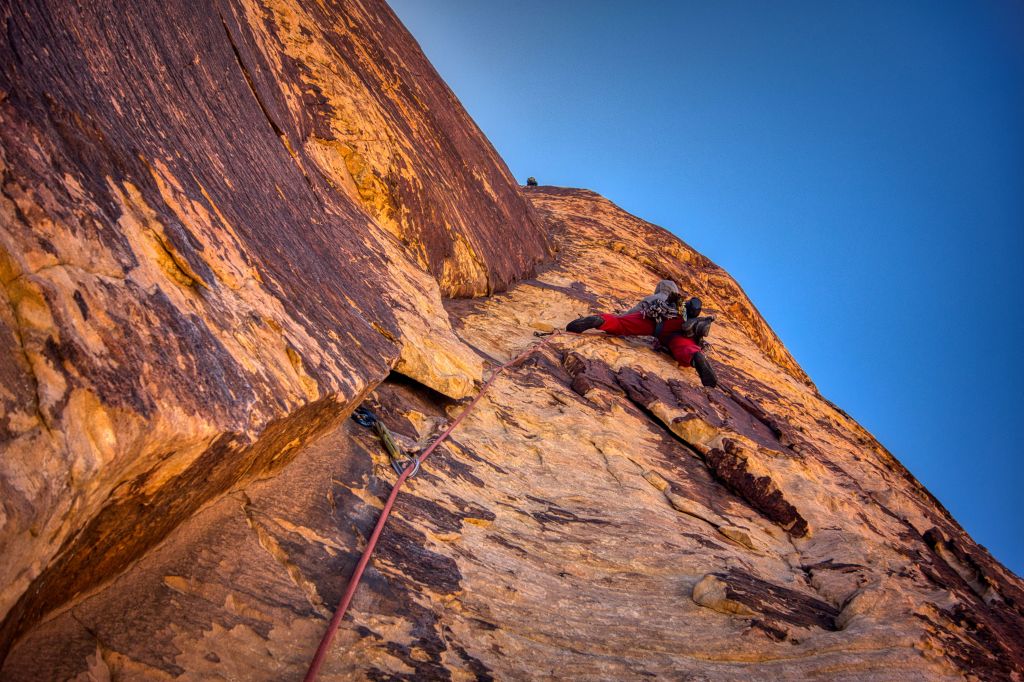
Pitch 9: 120′, 5.9: After this pitch, the face climbing begins to lose its appeal. The upper six pitches lack movement variety, and our primary motivation quickly shifted from enjoyment to efficiency—we simply wanted to get to the top as soon as possible. Gear here is #3 below the right facing flake, #2 above the flake, bolt below Rick’s left leg and bolt to the left above Rick’s head.
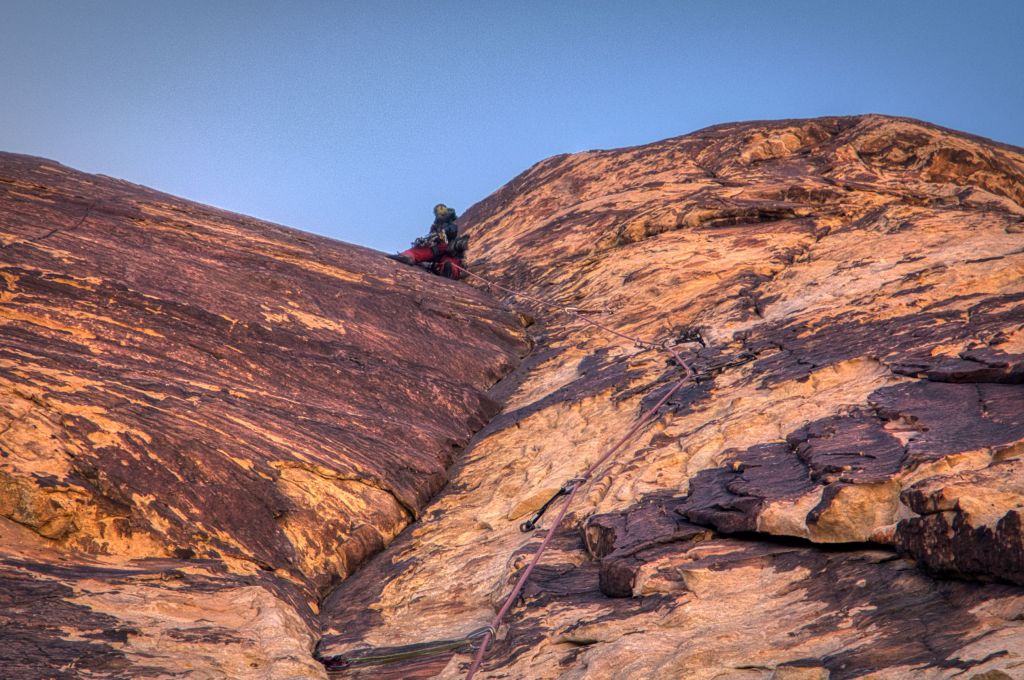
Pitch 9: 120′, 5.9: Upper section of P9. Lower bolt was the bolt above Rick’s head in previous picture. After that we have black totem and two more bolts.

Pitch 9: 120′, 5.9: P9 finish which protects with more finger pieces.

Pitch 10: 160′, 5.7: Mostly hand sized left corner crack with first pro being a #1.
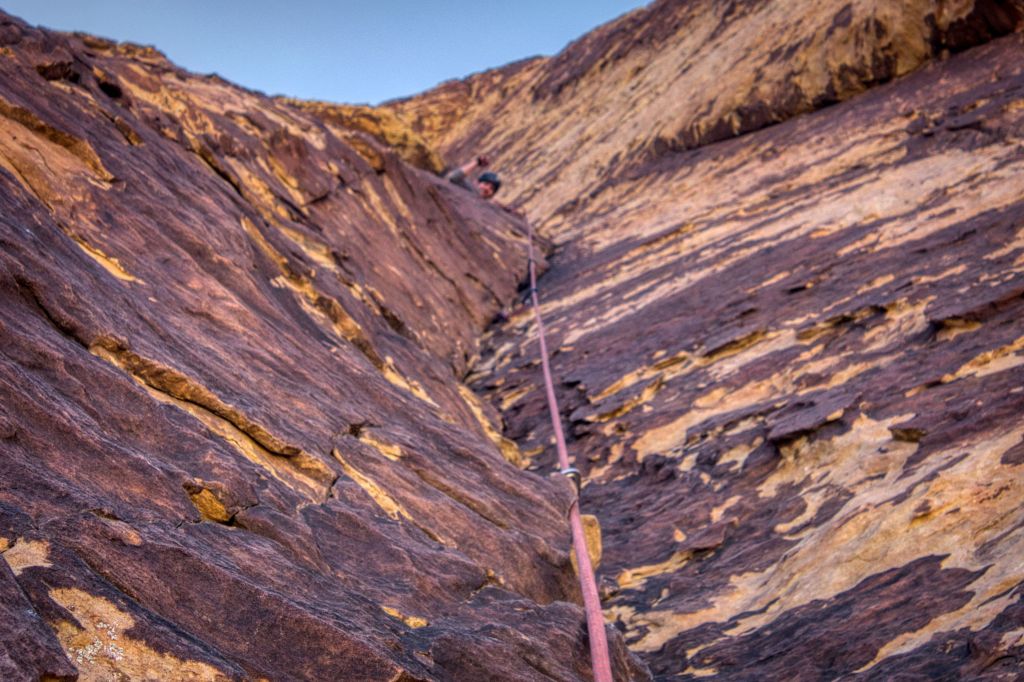
Pitch 10: 160′, 5.7: Pitch 10 finish that takes more hand sized cams.

Pitch 11: 140′, 5.9: This pitch stands out for a couple of reasons. While the guidebook notes “delicate moves below the roof” (visible at the top of the photo), the reality is that pitches 6 through 11 are filled with delicate face climbing—this one just happens to advertise it. The section Rick is inspecting includes a notably long runout, with the first protection opportunity—a 0.4 Totem—coming just after the right-facing feature above him. This stretch felt serious, not just to us, but also to the climbers below us. That 0.4 also became our first stuck piece of the route. It had turned inward—possibly during my extraction attempt—but it seemed to have walked deeper and became completely overcammed, despite being extended with a sling. After some effort, I left it behind. To our surprise (and gratitude), the follower from the party behind us managed to retrieve it and generously returned it. An absolute legend.

Pitch 11: 140′, 5.9: Close up of the roof, it protects with a .5 and .3 (this was again a bit stuck but I got it out after a bit of effort). The roof/bulge goes with a few layback moves and its pretty cool. This roof is alot easier than the roof on Positively 4th Street ( single pitch 5.9 in Yosemite) and the slick roof of pitch 3 on Central Pillar of Frency (Middle Cathedral, Yosemite).

Pitch 12: 160′, 5.7: This is the first pitch which was quite easy but almost 70m long with sparse pro. The party behind us complained about rope drag as well.

Pitch 12: 160′, 5.7: Upper section of pitch 12. Notice the sort of circular bulges on the left facing corner in picture above. This picture shows climbing after that section.
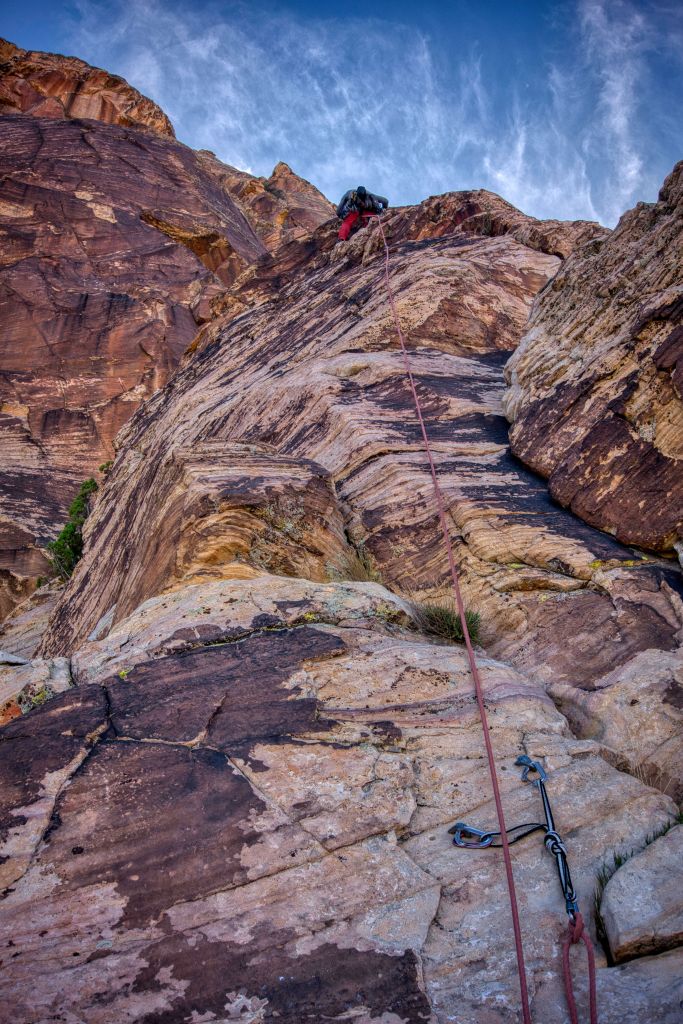
P13-16: 700′, 5.4: We did the ramp section in two pitches with simul-climbing. P12 has bolted anchors and this picture shoes the start of our P13.
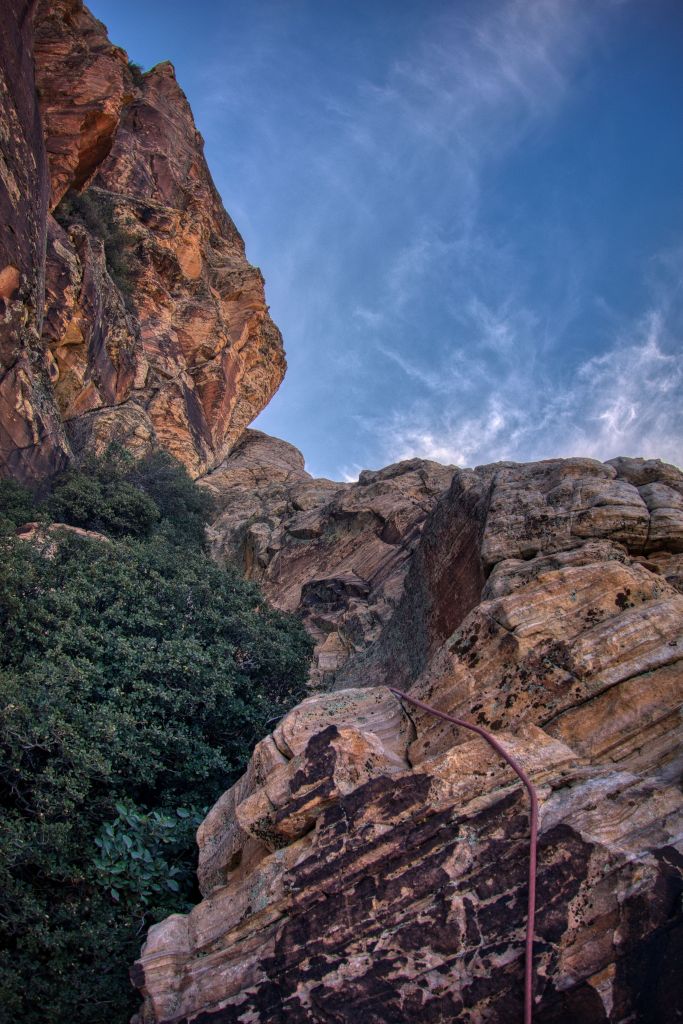
P13-16: 700′, 5.4: P13 continues

P13-16: 700′, 5.4: P14 start. We made a gear anchor with three finger pieces below on the left wall (not visible in this picture).

P13-16: 700′, 5.4: Final ramp, Rick looking at the Epi tree. While this section is a walk, the right side is completely exposed cliff. There are some hand and finger size pro to protect the ramp.
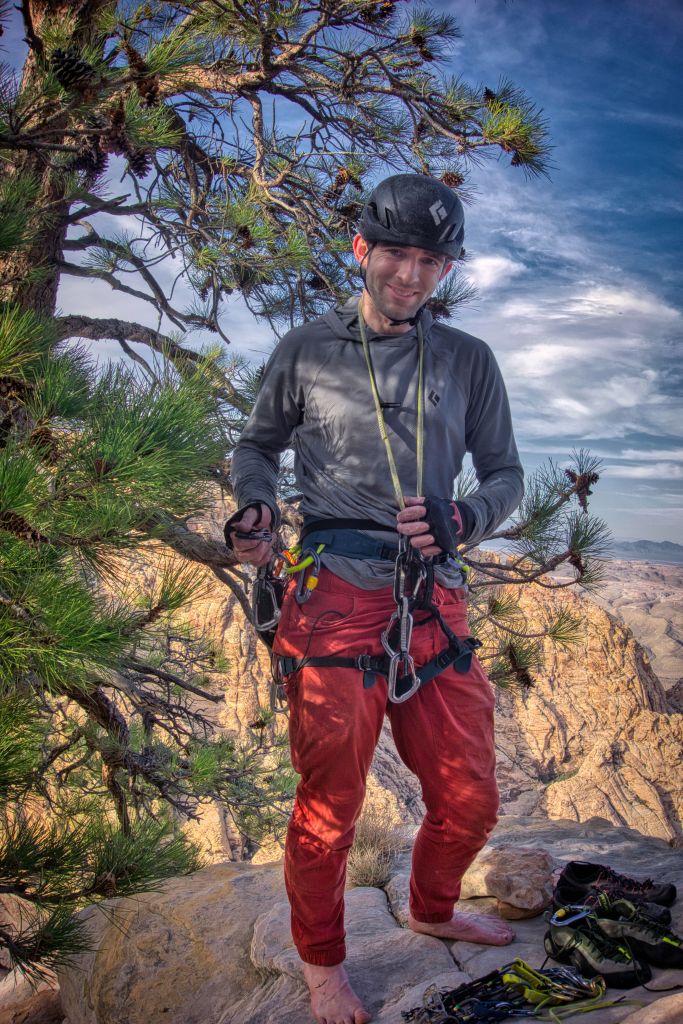

Rick : The EPI man on the summit by EPI tree, Sandy: The EPI woman on the descent trail.
We were fortunate to have 105 minutes of daylight remaining, which allowed us to reach the Frogland descent trail—terrain we knew well—before darkness set in. That said, headlamps are essential.
As noted in the descent stats under Epinephrine Overview, you’re now looking at a steep 2,400-foot descent over just 2.05 miles. Quads, knees, and focus—everything gets tested.
So, the question is:
Are you EPI ready?
 Dasherton Climbs
Thanks for the great detailed write up. I’d love a copy of the GPX files if you don’t mind. I’m planning a trip to Red Rocks in a few weeks and we’re trying to decide if we are Epi Ready.
LikeLike
Thank you Sasha. I will email them to you. Every pitch has bolted anchors so its certainly worth giving it a go.
LikeLike
many thanks for all this information. I’d love a copy of the GPX file as well
LikeLike
Thank you Jason, I have emailed it to you at the email id visible to me on your comment.
LikeLike
Hi Sandy,
Thanks for your sharing. I’d love a copy of the GPX.
LikeLike
Thank you, I have emailed it to you.
LikeLike
Thank you for the detailed post!! love following your journeys, could you please share the gpx for the approach and descent?
LikeLike
Thank you so much, I have emailed them to you.
LikeLike
Hi,
Congrats for the climb !
I am interested forthe 2 gpx files ! Thanks !
LikeLike
Hi, thank you. I have emailed the files to you.
LikeLike
What a great write-up! Thanks for taking the time to put this together!! I’d also love the gpx tracks, thanks!
LikeLike
Thank you so much Mike. Email incoming your way 🙂
LikeLike